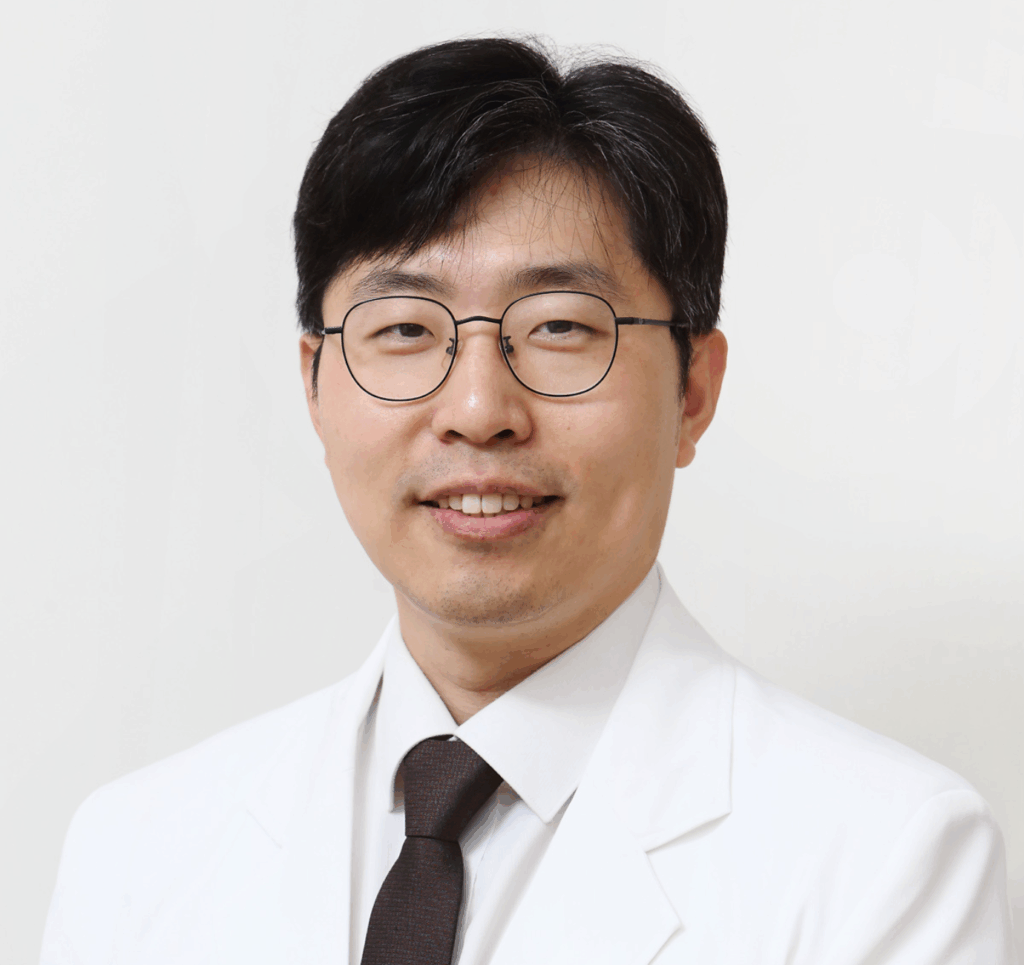
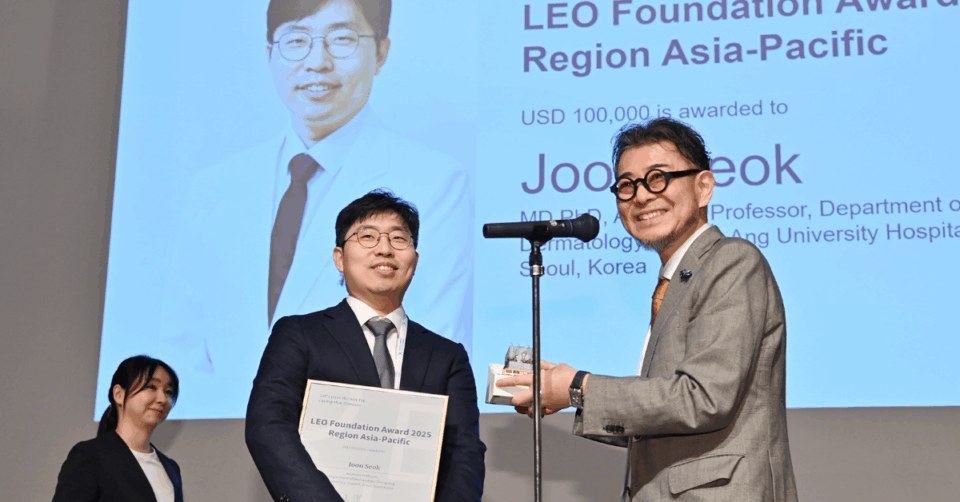
Dr. Joon Seok (to the left) received the 2025 LEO Foundation Award for the Asia-Pacific region on stage from JSID President and Professor Manabu Ohyama during the 50th Annual Meeting of the Japanese Society for Investigative Dermatology.
19 December 2025
Dr. Joon Seok received the 2025 LEO Foundation Award for the Asia-Pacific region during the 50th Annual Meeting of the Japanese Society for investigative Dermatology.
The LEO Foundation has announced Dr. Joon Seok, Assistant Professor at the Department of Dermatology, Chung-Ang University Hospital in Seoul, Korea, as the recipient of the 2025 LEO Foundation Award for the Asia-Pacific region. The award recognizes his outstanding contributions to advancing our understanding of skin diseases.
“It is a tremendous honor to receive the 2025 LEO Foundation Award for the Asia-Pacific region. This award is not only a personal milestone but also a great encouragement for our team to continue pushing the boundaries of translational dermatology,” Joon Seok says.
Understanding immune regulation in hair loss
Joon Seok’s research focuses on alopecia areata – an autoimmune condition that causes sudden, patchy hair loss.
“My inspiration came from patients who suffer from the unpredictable and distressing nature of alopecia areata. Many of them face both physical and psychological burdens, yet treatment options remain limited. I wanted to understand the immunological mechanisms driving the disease and explore novel therapeutic strategies that could restore hair growth by rebalancing immune tolerance,” he says.
Beyond alopecia areata, Joon Seok’s research focuses on understanding immune regulation in chronic skin inflammation, such as psoriasis and atopic dermatitis. His work explores the plasticity of tissue-resident immune cells and how restoring immune homeostasis can lead to long-term remission.
“I hope our research will ultimately contribute to more personalized and durable treatment strategies for patients,” Joon Seok says and continues:
“I believe that fundamental research lays the foundation for clinical progress. Even if not every experiment immediately leads to a treatment, each step expands our understanding of immune pathways and disease heterogeneity. In alopecia areata, our studies have highlighted the importance of bystander activation among pathologic immune cell populations. This insight may provide a new perspective on targeted therapies and help develop more refined strategies that restore immune balance rather than simply suppress all inflammatory pathways.”
Joon Seok’s career path:
- 2024 – present: Assistant Professor, Department of Dermatology, Chung-Ang University Hospital, Seoul, Korea
- 2023 – 2024: Clinical Assistant Professor, Department of Dermatology, Chung-Ang University Hospital, Seoul, Korea
- 2022 – 2023: Clinical Fellow, Department of Dermatology, Chung-Ang University Hospital, Seoul, Korea
- 2018 – 2022: Ph.D., (Immunology) Graduate School of Medical Science and Engineering, KAIST, Daejeon, Korea
- 2016 – 2018: Ph.D., (Dermatology) Chung-Ang University Hospital, Seoul, Korea
- 2014 – 2018: Resident, Department of Dermatology, Chung-Ang University Hospital, Seoul, Korea
- 2009 – 2013: M.D., College of Medicine, Chung-Ang University, Seoul, Korea